.png)
Literary E-Porfolio
- Earl L
- Dec 14, 2020
- 21 min read

Updated: Dec 31, 2020
PROFILE

ALVIN, 27, dealing with life through YouTube and Coursera. Finishing his bachelors degree in Business Management major in Marketing Management at Northern Mindanao Colleges, Alvin Earl is developing his hobbies of acrylic painting, fashion illustration and gardening during the pandemic. Here are some samples:


He is also an avid reader of Real Living (been collecting since high school), Monocle, Vogue Italia and Joel C. Rosenberg's fiction and non-fiction novels. He likes to have a dog and a cat. He is currently taking a ton of online courses at Coursera.org until February 2021 taking Marketing Management, Agile Thinking, Financial Accounting, to say the least.
Follow me at
TIMELINE OF THE DEVELOPMENT OF PHILIPPINE LITERATURE
FROM THE PAST TO THE PRESENT

I. PRE-COLONIAL (–BC TO 1564)
Characteristics
Based on storytelling named “oral traditions”
Common themes include the following: nature, supernatural events, and bravery of heroes.
Their literature mirrors their truth.
Their literature is straight to the point.
Language use is full of melody and rhythm.
The common themes found in the literary works are bravery of heroes, help from otherworldly powers, good harvest, good versus evil, love, and nature.
Literary Forms
1. Oral Literature
Riddles
i. Bugtong — battle of wits among participants
ii. Tigmo (Cebuano)
iii. Paktakon (Ilonggo)
iv. Patotdon (Bicolano)
Proverbs (salawikain) — wise saying that contain a metaphor used to teach as a food for thought.
Tanaga — a mono-riming heptasyllabic quatrain expressing insights and lessons on life is “more emotionally charged than the terse proverb and thus has affinities with the folk lyric”.
2. Folk Songs — a form of fold lyric which expresses the hopes and aspirations, the people’s lifestyles as well as their loves. These are often repetitive and sonorous, didactic and naïve.
Hele or oyayi (Ilongo) — lullaby
Mambagu (Kalinga) — rice pounding song
Ambahan (Mangyan) —7-syllable per line poem that are about human relationships and social entertainment.
Kalusan (Ivatan) — work songs that depict the livelihood of the people
Tagay (Cebuano and Waray) — drinking song
Kanogan (Cebuano) — song of lamentation for the dead
Kissa (Tausug) — Parang Sabil, song of a Muslim hero who seeks death at the hands of Non-Muslims
3. Folk Tales
Myths — explain how the world was created, how certain animals possess certain characteristics, why some places have waterfalls, volcanoes, mountains, flora or fauna.
Legends — explain the origin of things
Fables — used an animal characters and allegory
Fantastic Stories — deal with underworld characters such as “tiyanak”, “aswang” “kapre” and others.
4. Epics — these are narratives of sustained length based on oral tradition revolving around supernatural events or heroic deeds.
Guman (Subanon)
Darangen (Maranao)
Hudhud (Ifugao)
Ulahingan (Manobo)
Lam-ang (Ilocano)
Mangovayt Buhong na Langit (The Maiden of the Buhong Sky) (Tuwaang-Manobo)
Ag Tobig neg Keboklagan (Subanon)
Tudbulol (T’boli)
5. Love Songs
Panawagan and Balitao (Ilongo)
Harana (Cebuano) — serenade
Bayaok (Maranao)

II. SPANISH COLONIZATION PERIOD (1565–1863)
Characteristics
It has two distinct classifications: religious and secular.
“Oral traditions” was transcribed by Priests and added religious themes.
The conquerors introduced Spanish as the medium of communication.
The common themes found in the literary works are bravery of heroes, good vs. evil, grace, love, and nature.
Literary Forms
1. Religious Literature — religious lyrics written by Iadino poets or those versed in both Spanish and Tagalog were included in early catechism and were uses to teach Filipinos the Spanish language.
Memorial de la vida cristiana en lengua tagala (Guidelines for the Christian Life in the Tagalog Language) (1605)
i. Salamat nang walang hangan/gracias de sin sempiternas (Unending Thanks) (1605) by
Fernando Bagonbata
Pasyon — long narrative poem about the passion and death of Christ.
i. Ang Mahal na Passion ni Jesu Cristong Panginoon Natin (1703) by Gaspar Aquino de
Belen
ii. Casaysayan nang Pasiong Mahal ni Hesucristong Panginoon Natin na Sucat Ipag-alab
nang Puso nang Sinomang Babasa (1814) foreword by Dr. Mariano Pilapil
Senakulo — dramatization of the pasyon, it shows the passion and death of Christ .
2. Secular (non-religious) Literature
Awit — colorful tales of chivalry made for singing and chanting.
i. Korido at Buhay na Pinagdaanan ng Tatlong Prinsipeng Magkakapatid na anak ni
Haring Fernando at ni Reyna Valeriana sa Kahariang Berbany (Ibong Adarna)
Korido — metrical tale written in octosyllabic quatrains
Prose Narratives— written to prescribe proper decorum.
i. Dialogo (dialogue)
a. Pagsusulatan ng Dalawang Binibini na si Urbana at si Feliza (1864) by Modesto
de Casta
ii. Manual de Urbanidad (conduct book)
iii. Ejemplo (exemplum)
iv. Tratado

III. NATIONALISTIC/PROPAGANDA AND REVOLUTIONARY PERIOD (1864–1896)
Characteristics
Planted seeds of nationalism in Filipinos
Language shifted from Spanish to Tagalog.
Addressed the masses instead of the “intelligentsia”.
The common themes found in this period are appearance versus reality, betrayal, rich versus poor, love, motherland, patriotism, and wartime loss.
Literary Forms
Propaganda Literature—Reformatory in objective
Political Essays— satires, editorials and news articles were written to attack and expose the evils of Spanish rule.
i. La Vanguardia (1881)
ii. Diariong Tagalog (1882) —founded by Marcelo H. Pilar
iii. La Solidaridad (1889) — editor-in-chief is Graciano Lopez Jaena
iv. Liwanag at Dilim (1896) — Emilio Jacinto
Political/Non-political Novels
i. Ninay (1885) — considered the first Filipino novel by Pedro Paterno
ii. Noli Me Tangere (1887) and El Filibusterismo (1891) — Jose Rizal’s masterpieces that
paved the way to the revolution.
2. Revolutionary Literature — more propagandistic than literary as it is more violent in nature and demanded complete independence for the country.
Political Essays — helped inflame the spirit of revolution
i. Kalayaan (1886) — newspaper of the society, edited by Emilio Jacinto.
Poetry
i. El Verdadero Decalogo (True Decalogue) (1898) — Apolinario Mabini
ii. Hibik ng Filipinas sa Inang Espanya (The Appeal of the Philippines to Mother Spain)
(1888) – by Hermenegildo Flores talked about Philippines as a poor and abused
daughter of Spain. It has 66 quatrains.
iii. Sagot ng Espana sa Hibik ng Pilipinas (The Answer of Spain to the Appeal of the
Philippines) (1889) – by Marcelo H. del Pilar, having 82 quatrains, talked about the
wonderful plans of Spain for the Philippines but did not able to deliver them.
iv. Katapusang Hibik nang Pilipinas sa Ynang Espana (The Last Appeal of the Philippines
to Mother Spain) (1896) – by Andres Bonifacio expressed his disgust to Spain like a
mother who was negligent and a renegade to her daughter, the Philippines. It has 14
quatrains.

IV. AMERICAN COLONIAL PERIOD (1897–1945)
Characteristics
The common themes found in this period are betrayal, forgiveness, grace, love, motherland, patriotism, and revenge.
A. Period of Apprenticeship (1910–1930)
Filipino Writers imitated English and American models.
American troops used the English language to pacify the Filipino people and instill in them the American ideals of “universality, practicality, and democracy”.
Poems written were amateurish and sloppy, which phrasing and diction is awkward and artificial.
Local magazines and publications were established to further the Filipino literature.
i. Renacimiento Filipino (1910)
ii. La Nueva Era (1910)
iii.El Debate (1917)
Institutions were founded to help boost the spread of the English language.
i. Daily Bulletin (1900)
ii. Philippine Normal School (1901)
iii. The Cablenews (1902)
iv. Philippine Free Press (1905)
v. University of the Philippines (1908)
vi. Student Publications
a. The Filipino Students’ Magazine (1905) of the Berkeley, California Filipino
government scholars
b. UP College Folio (1910) of University of the Philippines
c. The Coconut (1912) of the Manila High School
d. The Torch (1913) of the Philippine Normal School
Literary Forms
1. Short Stories
Dead Stars (1925) — Paz Marquez Benitez
The Small Key (1927) — Paz Latorena; won third place in Jose Garcia Villa’s Roll of Honor for the year’s best short stories.
Footnote to Youth (1933) — Jose Garcia Villa; tackles the responsibilities and realities that come with marriage and the family life.
2. Novels
Child of Sorrow (1921) — first novel in English by Zoilo Galang; heavily influenced by the sentimentalism of the Tagalog prose narratives of the eighteenth and nineteenth centuries.
B. Period of Emergence (1920–1942)
Newspapers and magazines were founded to help introduce to the reading public the works of Paz Marquez Benitez, Jose Garcia Villa, Loreto Paras, and Casiano Calalang among others.
i. Philippine Education Magazine (1924) — renamed Philippine Magazine (1928)
ii. Manila Tribune (1946)
iii. The Graphic
iv. The Woman’s Outlook (1924)
v. The Woman’s Home Journal (1926) — the official organ of the National Federation of
Women's Clubs of the Philippines
Highly influenced by Western literary trends like Romanticism and Realism.
Vernacular magazines published their first issues around this period.
i. Liwayway (1922) - contains Tagalog serialized novels, short stories, poetry, and many
others. In fact, it is the oldest Tagalog magazine in the Philippines.
ii. Bisaya (1930) - has the record of being the oldest magazine in Cebuano which is still
published, and "the most successful periodical in Cebuano".
iii. Hiligaynon (1934) - promotes Ilonggo culture and arts by printing articles in the native
language, thus giving non-English Ilonggo readers a better understanding of their own
heritage.
iv. Bannawag (1934) - contains serialized novels/comics, short stories, poetry, among
others, that are written in Ilokano, a language common in the northern regions of the
Philippines.
The 1940 First Commonwealth Literary Awards were given by President Manuel Quezon to the following winners:
i. Literature and Essay (Essay) — Salvador P. Lopez
ii. How My Brother Leon Brought Home a Wife and Other Stories (Short Story) —
Manuel Arguilla
iii. Like The Molave (Poetry) — R. Zulueta de Costa
iv. His Native Soil (Novel) — Juan C. Laya
Literary Forms
1. Poetry
Filipino Poetry (1924) — Rodolfo Dato
English-German Anthology of Filipino Poets (1934) — Pablo Laslo
Many Voices (1939) and Poems of Doveglion (1941) — Jose Garcia Villa
Poems (1940) — Angela Manalang
2. Short Stories — most prevalent literary form
Jose Garcia Villa — earned the international title “Poet of the Century”

V. JAPANESE OCCUPATION (1942–1960)
1. War Years (1942–1944)
Tagalog poets broke away from the Balagtas tradition and instead wrote in simple language and free verse
The common themes found in this period are grace, love, nature, patriotism, revenge.
Fiction prevailed over poetry.
i. 25 Pinakabuting Maikling Kathang Pilipino (1943)—compilation of the short story
contest by the military government
a. Suyuan sa Tubigan — Macario Pineda
b. Lupang Tinubuan — Narciso Reyes
c. Uhaw ang Tigang na Lupa — Liwayway Arceo
2. A. Period of Maturity and Originality (1945–1960)
Bountiful harvest in poetry, fiction, drama and essay
Filipino writers mastered English and familiarized themselves with diverse techniques.
Literary “Giants” prevailed
i. Palanca Awards for Literature
i. Nick Joaquin — La Vidal (1958) (Short Story)
ii. NVM Gonzales — Children of the Ash-covered Loam (1952) (Short Story)
— Lupo and the River (1953) (Short Story)
— On the Ferry (1959) (Short Story)
iii. Gilda Cordero Fernando - The Morning Before Us (1954) (Short Story)
— Sunburn (1957) (Short Story)
iv Bienvenido Santos
VI. CONTEMPORARY/MODERN PERIOD (1960–1999)
Characteristics
Martial Law repressed and curtailed human rights, including freedom of the press
The common themes found in this period are appearance versus reality, good versus evil, justice, love, and nature.
Writers symbolisms and allegories to drive home their message, at the face of censorship
Theater was used as a vehicle for protest, such as the PETA (Philippine Educational Theater Association) and University of the Philippines (UP) Theater.
The Commission on Higher Education (CHED) required teaching of Philippines Literature in all tertiary schools in the country emphasizing vernacular literature.
From the eighties onward, writers continue to show dynamism and innovation
Literary “giants” awards continued .
i. Nick Joaquin — Doña Jeronima (1965) (Short Story)
—The Beatas (1976) (Full-Length Play)
ii. NVM Gonzales — The Tomato Game (1972) (Short Story)
iii. Gregorio Brillantes — Faith, Love, Time & Dr. Lazaro (1960) (Short Story)
—Journey to the Edge of the Sun (1962) (Short Story)
— Janice Joplin, The Revolution and the Melancholy Widow of Gabriela
Silang Street (1977) Short Story)
—Rizal, Balaguer, and Teilhard: Convergence at the Luneta (1983) (Essay)
iv. Gilda Cordero Fernando — A Wilderness of Sweets (1964) (Short Story)
National Artist for Literature Awardees
i. Jose Garcia Villa (1973)
ii. Nick Joaquin (1976)
iii. Carlos P. Romulo (1982)
iv. Francisco Arcellana (1990)
v. Ryan Christopher Joson (1997)
vi. Rolando S. Tinio (1997)
vii. Levi Celerio (1997)
viii. Edith L. Tiempo (1999)

VII. POSTMODERN AND CURRENT (2000-)
Characteristics
Writers gained access to a wide array of resources via the Internet and give people opportunities, especially the youth, to begin writing and expressing their youths, ideals, and feelings. One example is thru WattPad.
The common themes found in the current period are appearance versus reality, isolation, motherland, nature, and patriotism.
Many works deal with events, movements, and literary works of the past in order to make sense of the present.
Literary “giants” awards continued
National Artist for Literature Awardees
i. F. Sionil Jose (2001)
ii. Virgilio S. Almario (2003)
iii. Alejandro Roces (2003)
iv. Lazaro A. Francisco (2009)
v. Cirilo F. Bautista (2014)
Literary Genres
Creative Nonfiction – can be an essay, a journal article, a research paper, a memoir, or a poem consisted of a mixture of flavors, ideas and techniques.
i. The Cardinal Sins, the General’s Cross, the Martyr’s Testimony, and
Other Affirmations (2007) by Gregorio C. Brillantes
ii. Sapay Koma (2008) by Jhoanna Lynn Cruz
Hyper Poetry – uses the computer screen as the medium, rather than the printed page relying on the qualities unique to a digital environment, such as World Wide Web pages.
Mobile Phone Text Tula – written originally on a cellular phone via text messaging that came from Japan yet spread throughout China, United States, Germany, and South Africa.
Chick Lit – addresses issues of modern womanhood – from romantic relationships to female friendship to matters in the workplace – in humorous and lighthearted ways.
i. The Harder We Fall (Spotlight New Adult) (2014) by Mina V. Esguerra
ii. Tall Story (2010) by Candy Gourlay
iii. All’s Fair in Blog and War (2013) by Chrissie Perla
Speculative Fiction – deals with observations of the human condition but offers the experience through a different lens and challenges to see what tomorrow
i. Smaller and Smaller Circles (2002) by FH Batacan
ii. "Sink," Philippine Speculative Fiction Volume V (2010) by Isabel Yap
iii.The Secret Origin of Spin-Man (2009) by Andrew Drilon
Flash Fiction – also named as microfiction, microstories, short short stories and nanoficiton, based on word count and considering several features such as clarity, brevity, background and purpose.
i.100 Kislap (2011) by Abdon M. Balde Jr.
ii. Karapote: Antolohia Dagiti 13 a Nasuerte A Sarita (2011) by Ariel S. Tabag
Blog – short for weblog, is a journal or informational website displaying information in the reverse chronological order.
Graphic Novel – a longer work or collection of works presented in comic style
i. The Mythology Class (Nautilus Comics) (1999) by Arnold Arre
ii. Light (Anino Comics) (2015) by Rob Cham
iii. Sixty Six (Anino Comics) (2015) by Russell Molina
iv. Maktan 1521 (2011) by Tepai Pascual
I. POETRY

MAKABUHAY
Nemecio E. Caravana
Makabuhay is a quatrain written by renowned post-World War 2 actor and film director, Nemesio E. Caravana. Makabuhay is the Tagalog name for Tinospora crispa (L.) Hook.f. & Thomson of the family Menispermaceae or is commonly known as heavenly elixir or divine nectar. It is a climbing vine found all over the Philippines. It is also known as a rasayana herb in Ayurvedic medicine. Alternative medicine used its stems and leaves for their antimalarial, parasiticidal and insecticidal properties. The author used its name as a symbol for bitterness for which the plant’s mucilage is famous. Then, bitterness is a symbol for suffering. Its given names, makabuhay, heavenly elixir, and rasayana, can also be attributed to the illustrations depicted in the poem.
The reader is the speaker of the poem found in the use of pronouns depicting a second-person point of view (POV) in the first lines of both first and second stanzas, Lubid kang luntiang sa gubat nanggaling and May dala kang ditang kapait-paitan. The speaker shares a synthesis of thanksgiving for the use of the makabuhay as an effective alternative medicine found at the first two lines of the third stanza, Sa maraming sakit, ikaw ay panlunas, At sa tagabukid ay gamot sa sugat. And, as a breastfeeding tip and a precaution for its bitter aftertaste found at the last two lines of the fourth stanza, Sa tamis, ang bata kapag namihasa, Munting kapaita’y mamalakhing dusa. The substantial use of literary devices is found in the four stanzas using irony between the bitterness of experience and the delight of restoration. Both the author and the speaker share the sentiment of appreciation and caution. The poem is about enduring and overcoming hardships in life. Bitterness plays as a connecting thread between alternative remedy and eternal remedy, between needs and wants, between the creation and the Creator, and between resistance and surrender. The last stanza is the core of the poem. It retells the story of Jesus Christ taking the suffering and humiliation of humankind at the cross at the Calvary. The last line of the poem, Ang taong masanay uminom ng luha, Sa sangmundong dusa’y hindi nalulula, is impactful yet saddening. According to the Bible, “In him, we have redemption through his blood, the forgiveness of our trespasses, according to the riches of his grace”. The words, makabuhay (and its mucilage), heavenly elixir, and rasayana attribute to the blood of Jesus Christ. The word makabuhay means to give life while elixir is an amalgamation of concepts found in the Epic of Gilgamesh, ancient China, and amrita of the Hindu traditions of the formula for immortality and cure of all diseases. Then, rasayana refers to the techniques for lengthening lifespans and invigorating the body. It is also worth noting that the author was living in a postwar period. According to Wuthnow and Andlinger, there was a growing awareness of seeking spirituality out of the confinement from religious establishments in America during the 1960s, 20 years after the end of the 2nd World War. This phenomenon trickled down in the Philippines through the immigration of missionaries thus might explain the religious connotation of the poem.
Overall, the author’s message to the readers is enduring and overcoming hardships in life like how Jesus Christ did it at the cross. While analyzing the poem in both cultural and historical lenses, the lesson instructs the readers to appreciate the gift of life and its chaotic tendencies. It is through sufferings that the human race are molded to excellence.
Reference:
1 Antidiabetic Effect of Oral Borapetol B Compound, Isolated from the Plant Tinospora crispa, by Stimulating Insulin Release. / Lokman FE, Gu HF, Wan Mohamud WN, Yusoff MM, Chia KL, Ostenson CG. / Evid Based Complement Alternat Med. 2013;2013:727602 / doi: 10.1155/2013/727602. Epub 2013 Nov 10.
2 New antimicrobial diterpenes from Tinospora rumphii. / Cruz, M. S. / Archives, Thesis Col. Graduate, 12F (Mezz.) Henry Sy Sr. Hall
3 Crossway Bibles. (2007). ESV: Study Bible: English standard version. Wheaton, Ill: Crossway Bibles.
4 Elixir of Life. (2020, November 23). In Wikipedia. https://en.wikipedia.org/wiki/Elixir_of_life#Names
5 Rasayana. (2020, October 17). In Wikipedia. https://en.wikipedia.org/wiki/Rasayana
6 Wuthnow, R. & Andlinger, G.R. (2000). After Heaven: Spirituality in America Since the 1950s. University of California Press. https://books.google.com.ph/books?hl=en&lr=&id=nNQ5Vh0RcPcC&oi=fnd&pg=PA1&dq=post+world+war+2+period+and+religious+seeking&ots=28kczgci6z&sig=uFse1QLObBrF-xke177CGSk_qeE&redir_esc=y#v=onepage&q&f=false
II. SHORT STORY

A QUESTION OF FIDELITY
Gémino Henson-Abad
Yes, he thought bitterly, it might be Zita, for she had become a creature of his disappointed memory; but also, No, for it was rather with having to be honest with Bianca, by a hurtful bridge of poor words, that he had crossed over a darkness.
- Paco thought after confessing to Bianca
What does it take to practice infidelity? What triggers cheating or straying from marital promise? Was it from the brain or the brawn? Fidelity means faithfulness to a person, a cause, or belief, demonstrated by continuing loyalty and support or simply put sexual faithfulness to a spouse or partner. A Question of Fidelity is a short story about a professional married man encountering a midlife crisis – the transition of identity and self-confidence that can occur in middle-aged individuals and described as a psychological crisis brought by a person’s growing age, inevitable mortality and possible lack of accomplishment in life. Paco is a creative director in the Asia-Pacific Ad World, Inc. who thought about his past and present fleeting feelings of women around his life. He exemplifies midlife crisis at its core. He thinks about his age more, about highly successful and creative ways to sell Coca-Cola and Philip Morris with the help of his secretary, Bianca, and a current battle against death by an accident.
The story unravels the two sides of a man – the professional, behaved, adapted, responsible and thoughtful and another the more daring, animalistic and vicious. The two sides of the coin were represented by the psychological warfare of the protagonist, Filo (inner self) and Paco (outer self). It is almost like Paco developed a split personality disorder after having out his sexual chances that lures within the confines of his heart. The name Filo derives from the Ancient Greek “philos” or “phileo” meaning beloved, dear, loving and show signs of affection while the name Paco is a variation of Francis and of Spanish and Latin origin for “from France”. Filo yearns for the affection and mutual intimacy with his wife, Agnes, a senior partner at a law firm. She is the total opposite for being strong, managerial and intensely loyal. Paco, on the other hand, awaits as a small spark to be burned. The capital of France, Paris, is known as the city of love and romance. However, there is called “Paris syndrome” which afflicts Japanese tourists who come to Paris expecting Le Vie en Rose only to discover the pitfalls of any modern city – traffic, noise, pick-pockets, high prices, etc. It resembles falling to temptation only results to corruption of the heart and the mind. Going back to Baguio, Paco was reminded of his first meeting, not that they really met. She is named Zita (Greek origin that means seeker). Bianca, his secretary is also his confidante who the one knew about the encounter. The two have a connection and Paco resorts to tell her that he has drawn to her. However, Bianca suggested something else other than her. Maybe Paco needs to make amends to Zita – to make amends to the one he seeks. But what does he seek?
The prose can be analyzed in a psychological manner and the use of name meaning to understand the characters. The protagonist is seeking for the restoration of intimacy with her wife and accepting into himself.
Reference:
Definition of MIDDLE AGE". www.merriam-webster.com.
FILÓ (n.d.) Namedoctor. Retrieved from: https://www.name-doctor.com/name-filo-meaning-of-filo-30228.html
What does Paco mean? (n.d.). Our Baby Names. Retrieved from: http://www.ourbabynamer.com/meaning-of-Paco.html
What does Zita mean? (n.d.). Our Baby Names. Retrieved from: http://www.ourbabynamer.com/meaning-of-Zita.html
III. DRAMA PERFORMED

HINAGPIS NG ISANG ANAK
Mabel Montefalco
Masakit? Hindi. Napakasakit. Isipin niya nga, sa loob ng maraming taon ni minsan sa aking panaginip ay hindi siya nagpakita. Iisa lang ang hiling ko sa Diyos na sana…sana… kahit
limang segundo magpakita siya kahit sa panaginip. Masilayan ko man lang ang kanyang mukha sa huling pagkakataon. Kahit isa lang, okay na ako. Masabi ko lang sa kanya na mahal na mahal ko siya.
Hinagpis ng Isang Anak or Lamentation of a Child is a monologue filled with emotions of sadness and longing for a father. The drama started with a rebuttal as if it was a cut from a scene. The protagonist, the speaker, and the empathizers or the responders debated regarding the protagonist's grip of melancholy to the speaker’s death. The second paragraph illustrated the speaker’s concern not just for oneself but his/her/their mother who suffered greatly. It rang true to all of us that family comes first especially in times of sorrows, failures, and tribulations. The third paragraph confirmed that the speaker lived in sorrow for a long time and was not healed or planned to move forward through the untimely demise. The speaker questioned death as injustice and as a thief. Even though the speaker’s friends empathized with his/her/their situation, the speaker was not open to restoration. Eventually, the speaker finally said that if his/her/their father will appear in a dream and be able to say, "I love you" they still are hoping for closure.
Reference:
Montefalco, M. (n.d.). Hinagpis Ng Isang Anak. Retrieved from Wattpad: https://www.wattpad.com/193161399-hinagpis-ng-isang-anak-monologo
IV. ESSAY
WHERE IS THE PATIS?
Carmen Guerrero-Nakpil
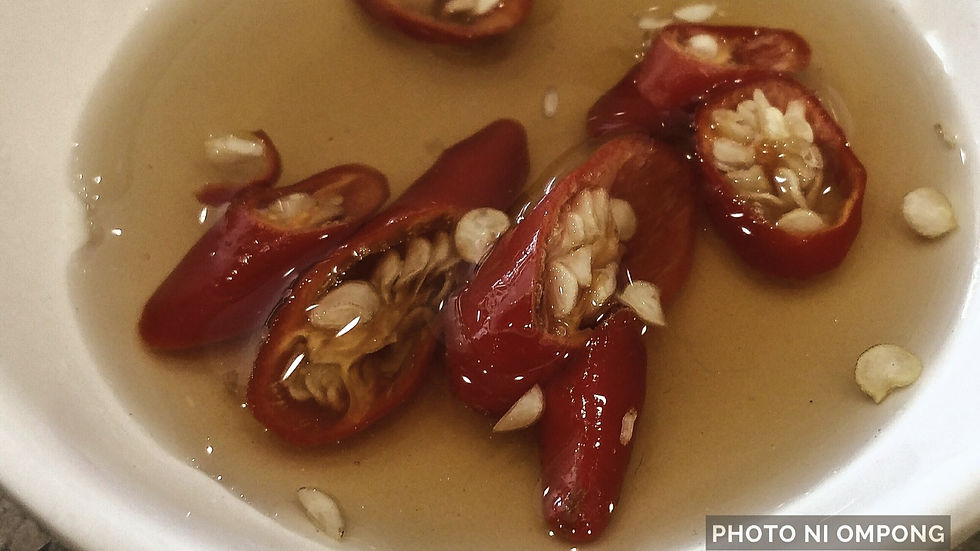
From adobong manok (vinegar-braised chicken), lechon baboy (roasted pig), lumpiang shanghai (spring rolls), all the way to nilagang baka (beef soup), fish sauce is an excellent condiment to boot. It’s a fermented condiment typically made from anchovies that’s glorious umami razzle-dazzle in a bottle. While nuoc mam (Vietnamese fish sauce) and nam pla (Thai fish sauce) are among the most widely available types of fish sauce in the U.S., it exists in slightly varying styles all over the world: ngan-pya-ye (Burmese), tuk trey (Cambodian), budu (Malaysian), patis (Filipino), colatura di alici (Italian), shottsuru (Japanese), aekjeot (Korean). Patis is the symbol of Filipino taste concentrated and developed throughout their lives. It will never be taken or washed away even Filipinos migrate, travel, and live in another country.
Filipinos were first introduced as a tourist in comparison with American who are dreamers, British who are seekers of high learning. They love to travel in far places and enjoying every culture possible thanks to a homegrown multicultural atmosphere and openness to experience add with a quick wit and casual flare. Filipinos are the best buddies to be around when traveling indeed. While not touring, they are also working and studying hard abroad to finance their family’s future and businesses and advance their career to greater heights. One of the mementos they carry is food and condiments. One of the reasons is they always connected with home through the tastes of condiments and Filipino recipes. Though wearing formal and winter wears, cosmopolitan, with American accent, Filipinos also wanted to be as far from their roots as. But one thing is sure, they also look for similar foods at home whether be found in Chinese, Korean or Malaysian restaurants. Siopao (steamed buns), pancit guisado, and mami (noodle soup) are staples of Filipino street food stalls that will not able to fully satisfy when seeking through Chinatowns worldwide. As the last paragraph says,
Better than a Chinese restaurant is the kitchen of a kababayan. When in a foreign city, Pinoy searches every busy sidewalk, theater, restaurant for the well-remembered golden features of a fellow- Pinoy. But make it no mistake.
Reference:
Beggs, A. (2020). There Are Millions of Ways to Use Fish Sauce, Which is Great Because It Never Goes Bad. Retrieved from Bon Appetit: https://www.bonappetit.com/story/cooking-with-fish-sauce
V. NOVEL

ILUSTRADO
Miguel Augusto Gabriel Jalbuena-Syjuco
“Literature,” he declared, “is an ethical leap. It is a moral decision. A perilous exercise in constant failure. Literature should have grievances, because there are so many grievances in the world. Let us speak frankly, because we’re all peers here. Your grievances with me are because you say I have failed. Though I only failed because I extended myself further than what any of you have ever attempted.”
- Miguel Syjuco, en route to Manila, December 1, 2002
-
Ilustrado was the Spanish term for the Filipino erudite – the enlightened one. They were the middle class educated in Spain and exposed to Spanish liberal and European nationalist ideals. Stanley Karnow referred to the ilustrados as the "rich intelligentsia" because many were the children of wealthy landowners who became the key figures in the development of Filipino nationalism. The most prominent ilustrados were Graciano López Jaena, Marcelo H. del Pilar, Mariano Ponce, Antonio Luna, and José Rizal, the Philippine national hero. Miguel Augusto Garbriel Jalbuena-Syjuco is a modern ilustrado himself in the sense that he completed his postgraduate studies abroad and traveled around the world. After receiving his BA in English Literature from the Ateneo de Manila University in 2000, he completed his MFA from Columbia University in 2004 and Ph.D. in Literature from the University of Adelaide in 2011. Born and raised in Manila, he is connected with a political family being his father, Augusto Syjuco Jr. the representative of Iloilo’s 2nd District.
The prose started with the body of Crispin Salvador, maestro of the author’s fictional character of the same name, floating in the Hudson River, New York City. The master was considered the greatest Filipino novelist dubbed as “The Panther of Philippine Letters” who was working for his latest novel, The Bridges Ablaze for two decades in New York City, away from the Philippines in self-proclaimed exile. His student undertook the writing of biography and discovered what it took to be a writer. Miguel learned little truths about Salvador and himself along the way. However, the reverse happened when Miguel drowned in the Pasig River following a typhoon and it was Crispin writing to make sense of the abrupt ending of his former student. Crispin decided to go back to the Philippines and made amends with his daughter.
In the prologue was a monologue of Miguel about the writing journey of his maestro. Chapter One was a mix of Crispin’s poetry, interviews, novels, polemics, and memoirs. Entitled “Eight Lives Lived”, Miguel started Crispin’s biography with some of the mentor’s motivational messages about writing. After nine months, he went back to the Philippines after reading an email from the supposed dead Crispin. Chapter Two showed Miguel’s strained relationship with his narcissist grandfather and politician-grandmother. Chapter Three saw the development of Miguel as a writer and the first-person narration of his childhood to adolescent life. Later on, his interview with Crispin’s sister, Lena, accused Crispin of misrepresenting the Salvador family and accidentally revealing Crispin’s daughter, Dulcinea. Chapter Four revealed a perilous dream of Miguel drowning in floodwater. Chapter Five was when Miguel found Dulcinea at the Hundred Island in Pangasinan and when he first-handedly witnessed a systemic explosion ordered by the current President to spark unrest and advance his dictatorial authorities. Chapter Six focused on an excerpt of Autoplagiarist, Crispin’s most controversial and last novel, about his uncle Jason, a guerilla soldier whom he idolized. It was also the time he met with his old flame, Sadie. Chapter Seven was an excerpt of Crispin’s relationship with Gigi Mitterrand and in Europea Quartet, mirroring her with Sadie. It was also the time Miguel remembered the dream of a “simple, everyday death”. Chapter Eight was when Crispin challenged how religion influenced governance in the Philippines and when he rebutted about living in the middle class was not as a privilege as one might assume. It was also the time when both Miguel and Sadie were warned by the police of something bad will happen. Chapter Nine was the change of the speaker from omniscient third-person to first-person voice – from Miguel to Crispin. It was also the time when both Miguel and Crispin met in a sort of afterlife. In his narration, Miguel survived the floodwaters and saved the children. An excerpt from Manila Noir described the protagonist Antonio Astig asked to forsake his quest for revenge. Chapter Ten alternates between the third person literary narration with Miguel’s experiences, esp the 1991 Mount Pinatubo explosion, and the first-person narration by Crispin. The epilogue explained Crispin discovered a letter about his student’s death changing the whole story from the death of the master to the death of its student.
Syjuco used different socio-political situations in the Philippines as a backdrop and connecting thread from reality like the use of illegal drugs, Huk rebellion, Marcos dictatorial regime, Roman Catholicism’s influence on the government, emergence of balikbayans, and the modern ilustrados. With these, the author perceives the novel as an eye-opener to his fellow citizens and foreign readers to understand the Philippines’ current and past socio-political landscape. The author also wanted to point out the sacrifices and different reasons Filipinos study and work abroad – an unmet expectation, for family’s financial advancement, for political and financial connections, and excellent higher education and work experiences. Death, good versus evil, patriotism, love, and family is common themes found in the novel. Death is a symbol of exclusion and upending of an ideal – to be independent, resilient, and mature. Miguel found these things near his deathbed and he still went through the process of knowing the truth even if that meant death. Crispin on the other hand, realized the role of an artist not only to deliver his work but to fully commit to acting his ideals. Overall, the novel was an outstanding premise of the beauty and ugliness of the Filipino spirit and the gray areas surrounding it.
Reference:
Glossary: Philippines, Area Handbook Series, Country Studies, Federal Research Division, Library of Congress, LOC.gov (undated), retrieved on: July 30, 2007
Lau, Joyce Hor-Chung (May 8, 2010). "An Expatriate Filipino Writes of a Parallel Life". The New York Times. Retrieved May 11, 2010.
Del Leon, Karylle (November 5, 2020). Ilustrado: A Book Review. YouTube (Video). https://www.youtube.com/watch?v=jqZrX0PVefQ
DRAMATIC PLAY
IN WHAT WAY PHILIPPINE LITERATURE BECOMES A VEHICLE IN PROMOTING THE FILIPINO CULTURAL HERITAGE?
Philippine literature provides an immense opportunity for adding value and resources to the Filipino cultural heritage. One of the primary ways is the ability to connect the past with the present as a crystallized memory of the people that developed the culture we have today through books, fiction and nonfiction novels, dramatic plays, etc. As a marketing management major, these stories are important in marketing for they add value and credibility to the brand, the establishment and the project of promoting Filipino culture heritage. Another way is medium of knowledge that the present generation can learn and emulate. One of the examples is the use of kundiman as a song of protest (Kundiman Party).
HOW GEC10 PHILIPPINES LITERATURE AFFIRM YOUR SENSE OF IDENITY AS A FILIPINO AMID MASSIVE FOREIGN INFLUENCES?
After reading short stories and novels and watching short and feature films, my sense of nationalism has risen. I got to know highly skilled and multi-awarded writers in a wide range of topics and generations. As an aspiring YouTuber/vlogger and businessman, I am now committed to add value to my videos/products connected with the local Cabadbaranon and national Filipino cultural heritage.
IN WHAT WAY THE STUDY OF PHILIPPINE LITERATURE HELP YOU ACHIEVE THE EXPECTED OUTCOMES OF NORMI TO YOU?
Studying Philippine literature provided a spring board in creating and supporting socially responsible endeavors and beliefs because the literary works and the lives of the writers/playwrights inspired me to make a positive change in the community.








Very detailed and easy for the reader to understand, good job!